
Artículo: How Sharp Should an Axe Be?
How Sharp Should an Axe Be?
One of the biggest misconceptions about axes is that they should be sharpened like knives. We often receive messages from customers asking, "Can you make it razor-sharp?" While that may sound like an improvement, the reality is quite the opposite.
A well-made axe isn't designed to shave hair or slice paper. It's designed to survive thousands of powerful impacts while continuing to cut efficiently. The secret lies not only in the steel – but also in the sharpening angle.
Why Axes Aren't Sharpened Like Knives
A typical kitchen or hunting knife has a very thin edge, often sharpened between 15° and 20° per side. This allows it to make extremely fine cuts through soft materials.
An axe faces a completely different job.
Every strike delivers tremendous force into wood, knots, bark, or even frozen timber. If an axe had the same thin edge as a knife, it would chip, roll, or become dull after only a few impacts.

Instead, axes use a much stronger edge geometry that sacrifices a little shaving sharpness in exchange for dramatically improved durability.
The goal is not to create the sharpest edge possible – it's to create the most effective edge for the intended task.
Choosing the Right Edge Angle
Different axes perform different jobs, so there isn't one "perfect" sharpening angle.
20-25° per side (40-50° Inclusive) – Best for carving axes and fine woodworking
This relatively thin edge slices deeply and cleanly into wood, making it ideal for carving, shaping, and detailed work. However, it requires more careful use and isn't intended for heavy chopping.
250-30° per Side (50-60° Inclusive) – The most versatile all-around edge
This is where many working axes and Viking-style axes perform best.
It offers an excellent balance between cutting performance, edge retention and durability.
This geometry handles general chopping, camping, bushcraft, and outdoor work very well.
30-35° per Side (60-70° Inclusive) – Built for durability
Heavier chopping axes, splitting axes, and tactical tomahawks often benefit from a steeper edge.
The thicker geometry resists damage when striking hardwood, knots, or other demanding materials. Although it won't shave like a knife, it will continue working long after a thinner edge has failed.
Why Tactical Tomahawks Use Different Sharpening
Modern tactical tomahawks have a different purpose than traditional axes.
Many are expected to perform demanding utility work where the edge may encounter:
- hardwood
- roots
- nails
- metal hardware
- construction materials
- repeated heavy impacts

Because of this, tactical tomahawks usually feature a stronger, more durable edge profile.
The emphasis is on reliability – not razor sharpness.
What About Throwing Axes?
Throwing axes often use a slightly more conservative edge than carving or bushcraft axes.

The reason is simple.
Repeated impacts against wooden targets gradually wear the edge. A slightly thicker bevel helps the blade survive thousands of throws while remaining easy to maintain.
A throwing axe only needs to be sharp enough to bite into the target – not sharp enough to slice like a knife.
Our Approach at AncientSmithy
We don't sharpen every axe exactly the same way.
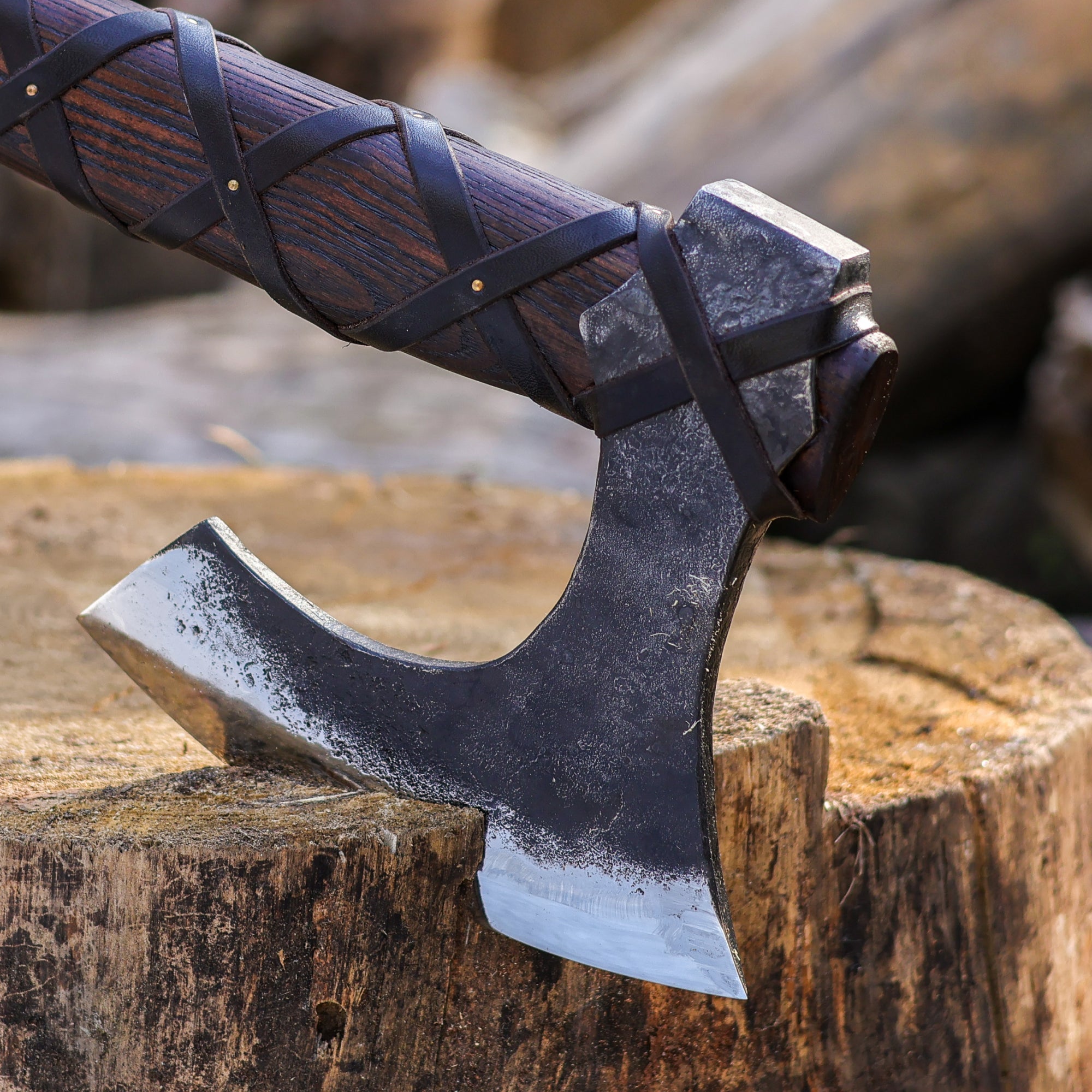
Instead, we choose the edge geometry based on the purpose of the tool. Our larger Viking axes receive an edge optimized for chopping and general outdoor use.

Our tomahawks are sharpened with durability and versatility in mind, allowing them to withstand repeated impacts while maintaining excellent cutting performance.
Every edge is finished by hand because small adjustments often make a significant difference in how an axe performs.
Keeping Your Axe Sharp
A sharp axe isn't created once – it's maintained over time.
Rather than waiting until the edge becomes completely dull, it's better to perform light maintenance regularly using:
- sharpening stones
- diamond plates
- ceramic sharpeners
- leather strops for light polishing

Removing a small amount of steel frequently is far easier than restoring a badly damaged edge.
It's also important to avoid excessive heat when using powered grinders, as overheating can reduce the hardness of the steel near the edge.
Sharp Enough for the Job
The best axe isn't the one with the thinnest edge. It's the one with the right edge.

A properly sharpened axe balances cutting performance, durability, and safety. It should bite deeply into wood, hold its edge through repeated use, and withstand impacts that would quickly damage a knife.
In the world of axes, sharpness is measured not by how easily it cuts paper – but by how well it performs after hundreds of swings.